How to tell real pashmina
Weight, weave and light: three simple checks you can make at any counter before you pay.
Shawls shipped across India in 3–5 days · Free monogram embroidery on stoles
22 Katra Jaimal Singh, near Hall Bazaar, Amritsar 143006
Mon–Sat · 10.30 am – 8.30 pm · Sun 12 – 6 pm
How the darning-stitch borders on our stoles are embroidered, and who embroiders them.
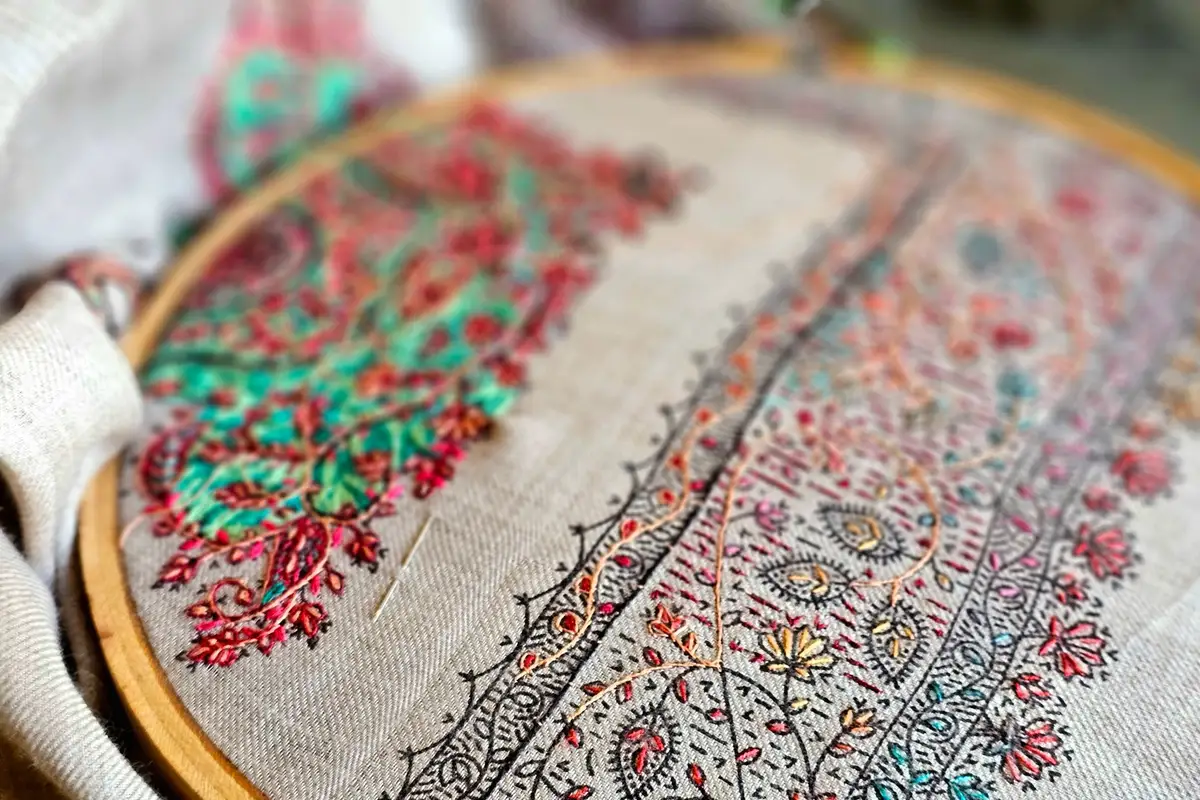
Phulkari, literally flower work, is the embroidery of Punjab: bright silk thread on handspun cotton, worked from the back of the cloth in long darning stitches so the pattern appears on the front. Traditionally women embroidered whole phulkaris and baghs for daughters’ weddings over years.
We do something smaller. Our wool stoles carry a 5 cm phulkari border, embroidered by a group of eleven women in villages near Patiala. Manpreet began working with them in 2008, when one of them brought a border to our counter in a cloth bag.
Each woman takes a batch of stoles home, already marked with chalk lines. She counts threads to place each stitch, which is why the geometry is so regular. A border along both ends of a stole takes about four days, worked in the afternoons between other work. Orange, pink and gold are the classic colours; we also ask for ivory on grey for customers who want something quieter.
We pay per border, agreed in advance, and collect the finished stoles every fortnight. Silk thread is costly, so a phulkari stole is priced at ₹3,900 rather than the ₹2,200 of a plain one. Turn the stole over: the back shows every stitch, and the work is honest on both sides.
Keep reading
Weight, weave and light: three simple checks you can make at any counter before you pay.
Clean, fold, breathe: how to keep moths and damp away from April to October.
From goat to shawl: an honest breakdown of the ₹18,500 on our plain natural pashmina.