Visiting us after the Golden Temple
How to get from the Harmandir Sahib to Lawrence Road, and what else is worth seeing on the way.
Every piece hand-darned in villages around Amritsar · Shipped across India in 4 days
41 Lawrence Road, near Novelty Chowk, Amritsar 143001
Mon–Sat · 10.30 am – 8 pm · Sun 12 – 6 pm
A ₹38,500 wari da bagh, broken down: cloth, silk, the maker’s time and the rest.
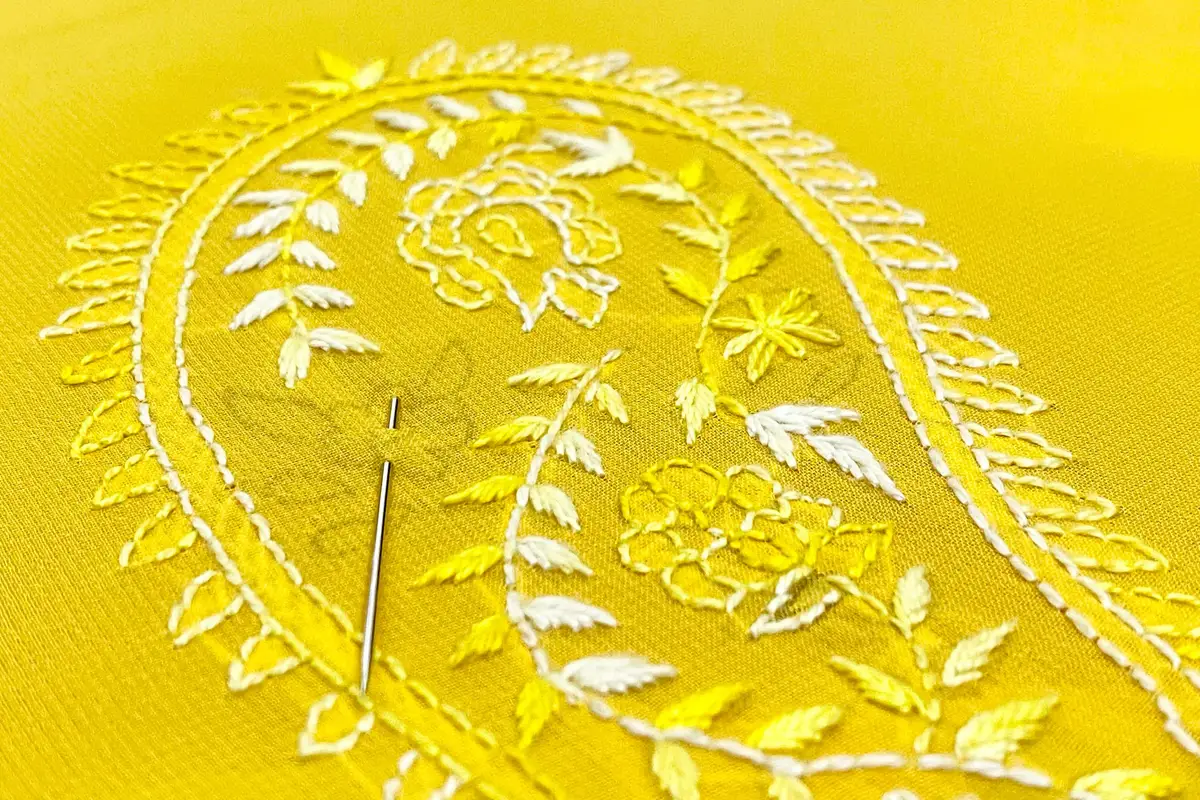
Customers sometimes ask why our wari da bagh costs more than a gold chain, when a machine phulkari from the bazaar costs a few hundred rupees. Here is what goes into it. The cloth is hand-spun, handwoven khaddar, dyed in Amritsar. A bagh needs about three metres in a double width, and it costs around ₹1,800. The silk floss is the next cost. A full bagh uses close to 600 grams of pat silk, which comes to about ₹6,500.
The largest share is the maker’s time. A full bagh takes one woman around 90 days of four to five hours each. We pay ₹23,000 for a piece like this, which is close to a skilled day wage in rural Punjab, and half of it is paid when the cloth is handed over.
That leaves about ₹7,200 for everything else: our monthly van to the villages, washing and finishing, the shop on Lawrence Road, packing and shipping, and the time spent checking every piece.
A cotton phulkari dupatta follows the same pattern on a smaller scale. Of its ₹6,800, about ₹3,900 goes to the maker for roughly three weeks of work. We would rather explain the price than lower it by paying less. If a hand-darned piece is beyond your budget now, our cushion covers and framed squares carry the same work in a smaller size.
Keep reading
How to get from the Harmandir Sahib to Lawrence Road, and what else is worth seeing on the way.
Will the colours run? A common worry, answered, with the simple way to wash a cotton phulkari at home.
What to expect when you order a bagh made to order: choices, timings, photos and payment.