Choosing a muhurtham saree
Colour, weight and zari: what to decide first, and what can wait.
Free shipping across India on orders above ₹2,999 · Cash on delivery available
14 Cross Cut Road, Gandhipuram, Coimbatore 641012
Mon–Sat · 10 am – 8.30 pm · Sun 11 am – 6 pm
Why the border and body are woven separately, and how to spot the joint.
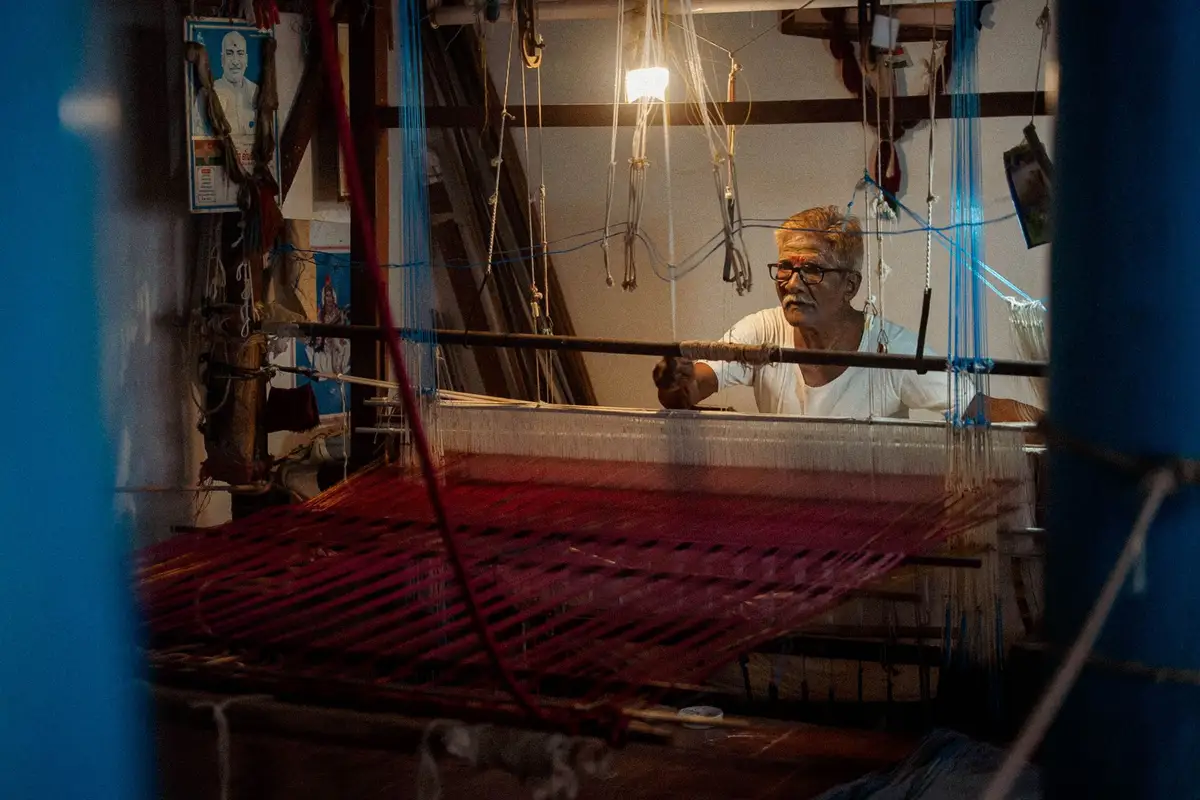
Korvai is a Kanchipuram technique where the border and the body of the saree are woven in different colours and then joined on the loom itself. It is the reason a maroon border can sit against a mustard body with a clean, sharp line, instead of the colours bleeding into each other.
To do it, the weaver works with three shuttles instead of one. The body weft is carried across the centre, and at each edge the border weft is interlocked with it by hand, thread by thread. That interlocking is slow. A plain soft silk might take five or six days on the loom; a korvai with a contrast pallu takes up to three weeks, with two people at the loom for much of it.
You can see the joint if you look closely at the back of the saree. Along the line where the border meets the body there is a faint zigzag where the threads have been looped around each other. On a printed or machine-made imitation the line is perfectly straight, and the back looks the same as the front.
The other test is the pallu. On a true korvai, the pallu is also woven separately and joined with a slightly raised ridge called the petni. Run your finger across it. If you feel it, the saree was woven the slow way.
Keep reading
Colour, weight and zari: what to decide first, and what can wait.
Weight, drape, zari and price compared, so you know which silk to ask for before you visit.
Seven measurements, one well-fitting blouse and a few photos are all our tailors need to stitch yours.