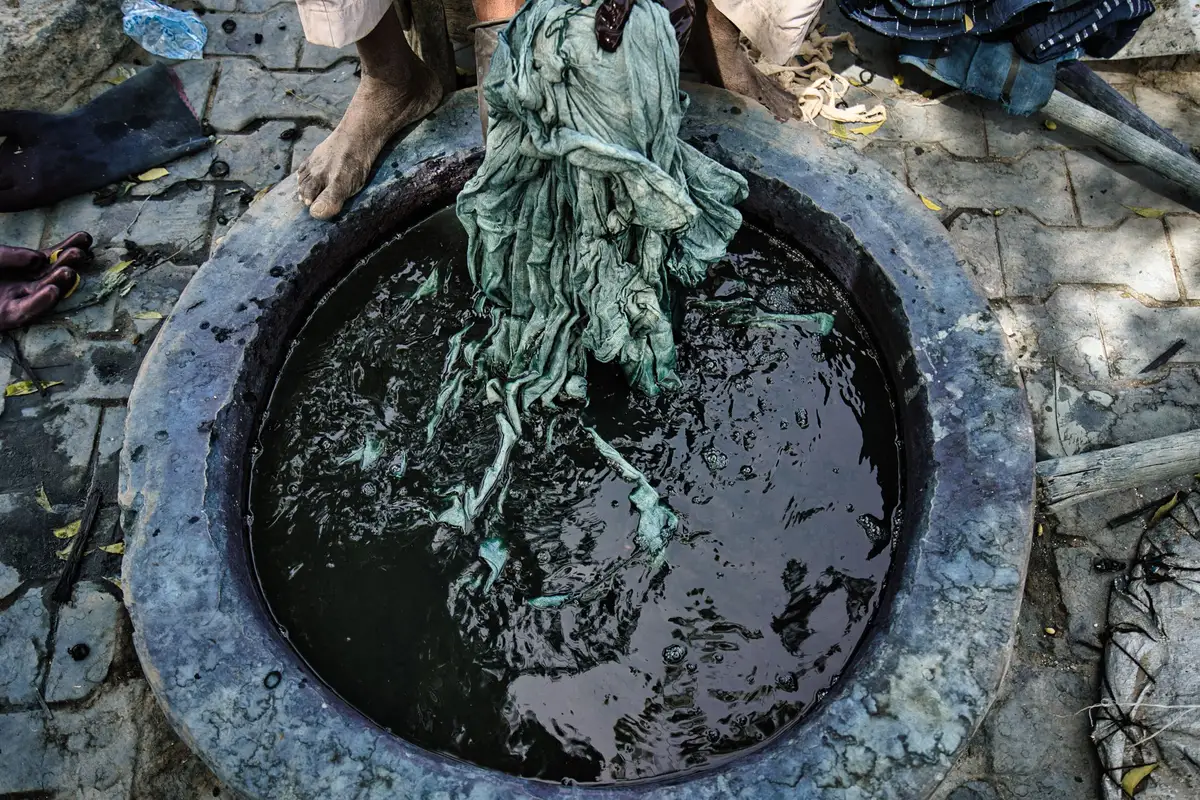
Is natural indigo really different?
A common question answered plainly: what natural indigo is, how it behaves, and what it costs.
Printed and dyed in our Jaipur workshop · Shipped across India in 4–6 days
41 Chhipa Mohalla, Sanganer, Jaipur 302029
Tue–Sun · 10 am – 7 pm · Sessions by booking
A day with the man who carves every teak block we print with, and why we keep the old ones.
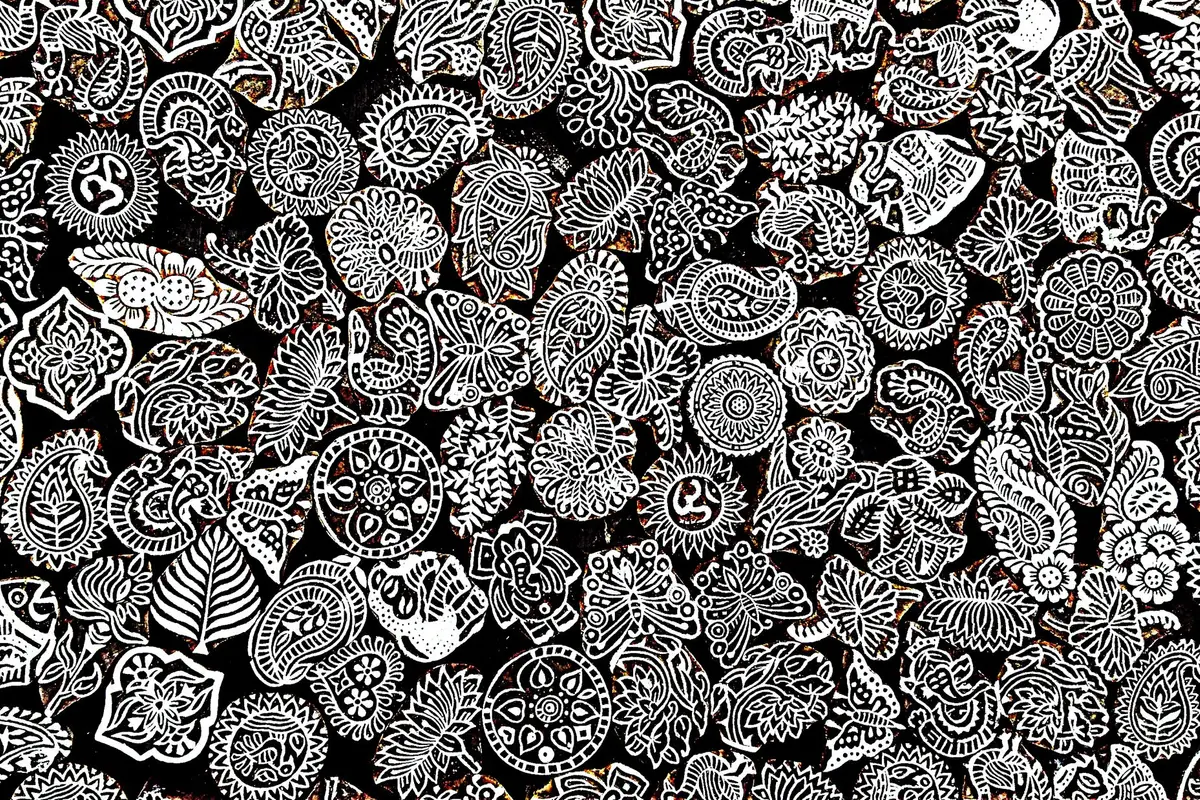
Every block we print with is carved by Salim-bhai, whose small room is two lanes from our workshop. He learned from his father, who carved for Gopal-ji in the 1970s, and his son now carves beside him.
The wood is seasoned teak, cut into blocks about 4 cm thick. Salim-bhai first planes the face perfectly flat, then rubs it with white chalk. The design is drawn on paper, pricked along its lines, and dusted onto the chalk. Then the carving begins, with a set of small chisels and a light wooden mallet.
A simple buti block takes two days. A large border block with fine lines can take two weeks. For dabu, the lines must be a little thicker than for colour printing, because the mud paste spreads. When a block is done, he drills small holes at the back so air can escape when it presses the cloth.
Before we use a new block, it soaks in oil for ten days to stop it cracking. A good block prints for years. When it wears, the lines soften and the print looks gentler, which many printers like.
We pay Salim-bhai by the block, at the price he names, and we have never bargained. We also keep every old block, some from 1972, on shelves above the printing tables. Now and then a customer asks for an old design, and we print it again.
Keep reading
A common question answered plainly: what natural indigo is, how it behaves, and what it costs.
What happens in the two hours, what to wear, and what you take home.
An honest breakdown of our ₹3,600 Sanganeri king bedsheet, from cotton to courier.