Your first printing session at the workshop
What happens in the two hours, what to wear, and what you take home.
Printed and dyed in our Jaipur workshop · Shipped across India in 4–6 days
41 Chhipa Mohalla, Sanganer, Jaipur 302029
Tue–Sun · 10 am – 7 pm · Sessions by booking
A common question answered plainly: what natural indigo is, how it behaves, and what it costs.
Indigo is a single blue molecule, and it can come from a plant or a factory. Most blue jeans in the world are dyed with synthetic indigo. So what is the difference, and is it worth paying for?
Natural indigo comes from the leaves of the indigo plant, fermented in water, oxidised and dried into a blue cake. Ours comes from farms in southern India, bought as powder. Because it is extracted from leaves, it carries small amounts of other plant compounds, which give it a slightly warmer, less flat blue than the synthetic kind.
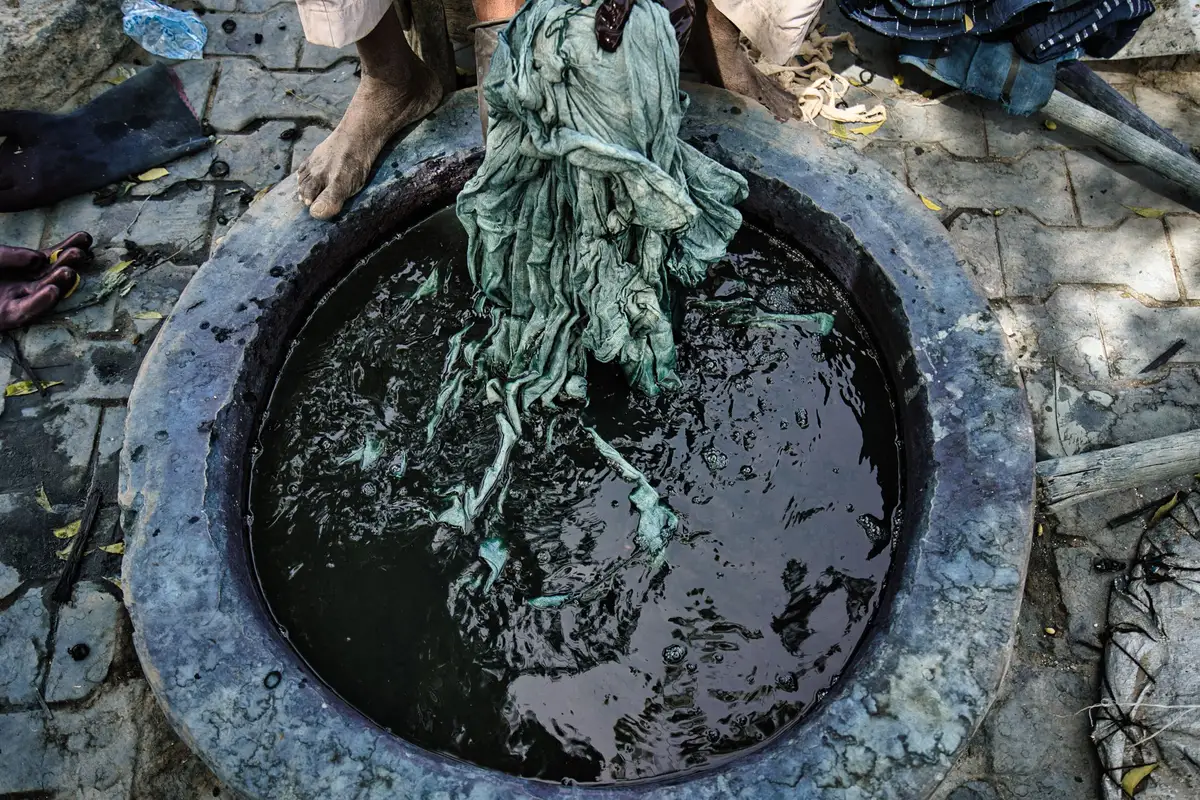
The bigger difference is in the vat. We keep our indigo in an earthen pit with lime and jaggery, a living vat that has to be fed and stirred and tested every day. It dyes slowly, so we dip again and again. Synthetic indigo is usually used with chemical reducers that work faster and harder on the cotton.
In use, natural indigo fades gently and evenly over years. It can crock, or rub off, slightly in the first weeks, which is normal.
It does cost more. Natural indigo powder costs us about eight times as much as synthetic, and the slow vat needs a dyer’s full attention. That is why a metre of our indigo dabu costs ₹420, while a screen printed blue cotton might cost ₹180 in the market.
Keep reading
What happens in the two hours, what to wear, and what you take home.
An honest breakdown of our ₹3,600 Sanganeri king bedsheet, from cotton to courier.
Why we dye most in winter, slow down in the monsoon, and plan your orders around it.