Visiting Sanganer and Bagru from Jaipur
Two printing towns within an hour of the city: how to get there, and what to see in each.
Printed and dyed in our Jaipur workshop · Shipped across India in 4–6 days
41 Chhipa Mohalla, Sanganer, Jaipur 302029
Tue–Sun · 10 am – 7 pm · Sessions by booking
Five things to look for, at the shop or on a product photo, before you pay for hand printing.
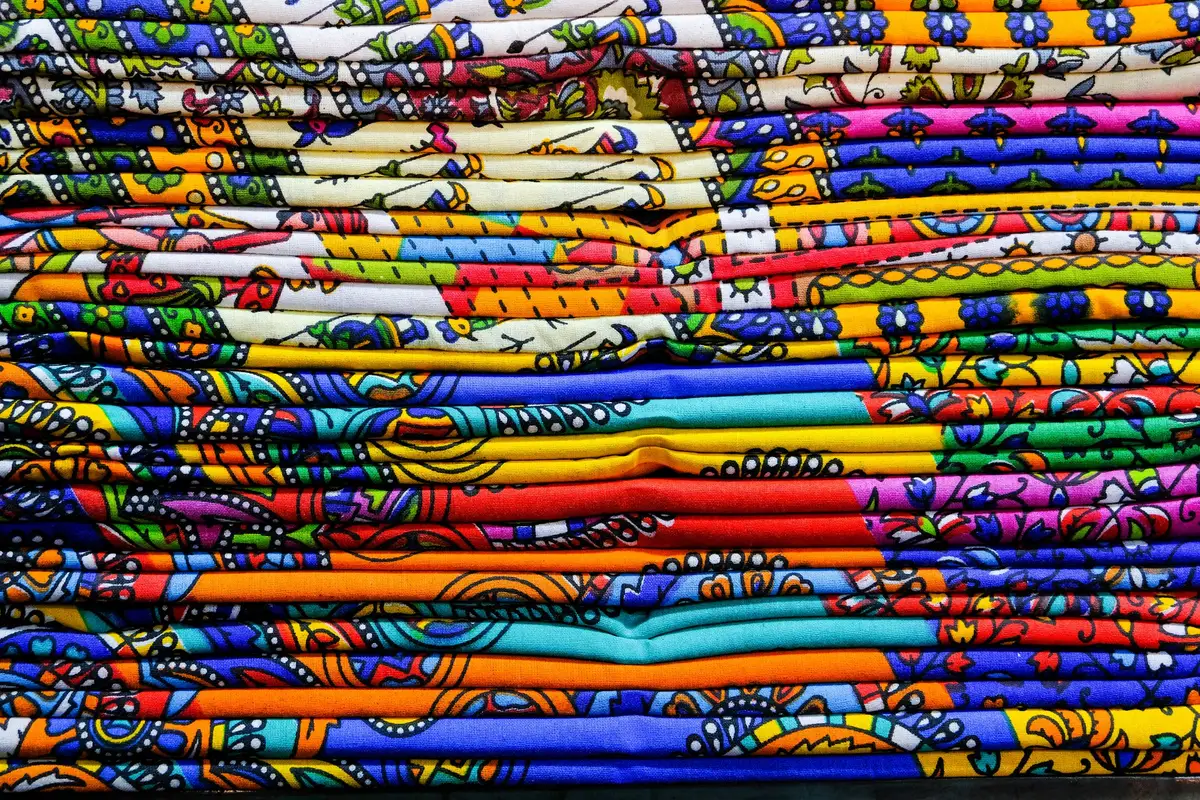
In our experience, much of the fabric sold as block print in markets today is screen printed. Screen printing is faster and cheaper, and there is nothing wrong with it, but it should cost less. Here is how to tell the two apart.
Look at the repeat. A block is small, often 10 to 20 cm, and placed by hand. You will find tiny joins, overlaps or gaps where one impression meets the next. A screen print repeats perfectly across a long width.
Turn the cloth over. In hand block printing, especially dabu and syahi, the colour soaks through and the reverse looks almost as strong as the front. Screen printing often leaves the reverse pale.
Check the outline. Each impression of a block has slightly uneven edges and small variations in colour, where the block took more or less dye. A screen print has crisp, identical outlines.
Look at the border. On a hand printed saree or bedsheet, the corners are tricky, and you can often see where the printer turned the block or used a separate corner block.
Finally, smell it. Natural indigo and dabu pieces often carry a faint earthy smell for the first few washes. If you are in Jaipur, come to the workshop and hold a hand printed piece and a screen printed one side by side. The difference is easy to see once you have seen it.
Keep reading
Two printing towns within an hour of the city: how to get there, and what to see in each.
Choosing weight, filling and print for a hand-quilted razai, and caring for it between winters.
A day with the man who carves every teak block we print with, and why we keep the old ones.