A wedding shopping day in Jaipur for out-of-town brides
Fabrics, juttis, bangles and lunch: how to plan a fitting weekend around the old city’s bazaars.
Bookings open for the November–February wedding season · First consultation free
C-42 Sardar Patel Marg, C-Scheme, Jaipur 302001
Tue–Sun · 11 am – 7.30 pm · by appointment
Tracing paper, a pin, chalk powder and an adda frame: the first week of making a bridal lehenga.
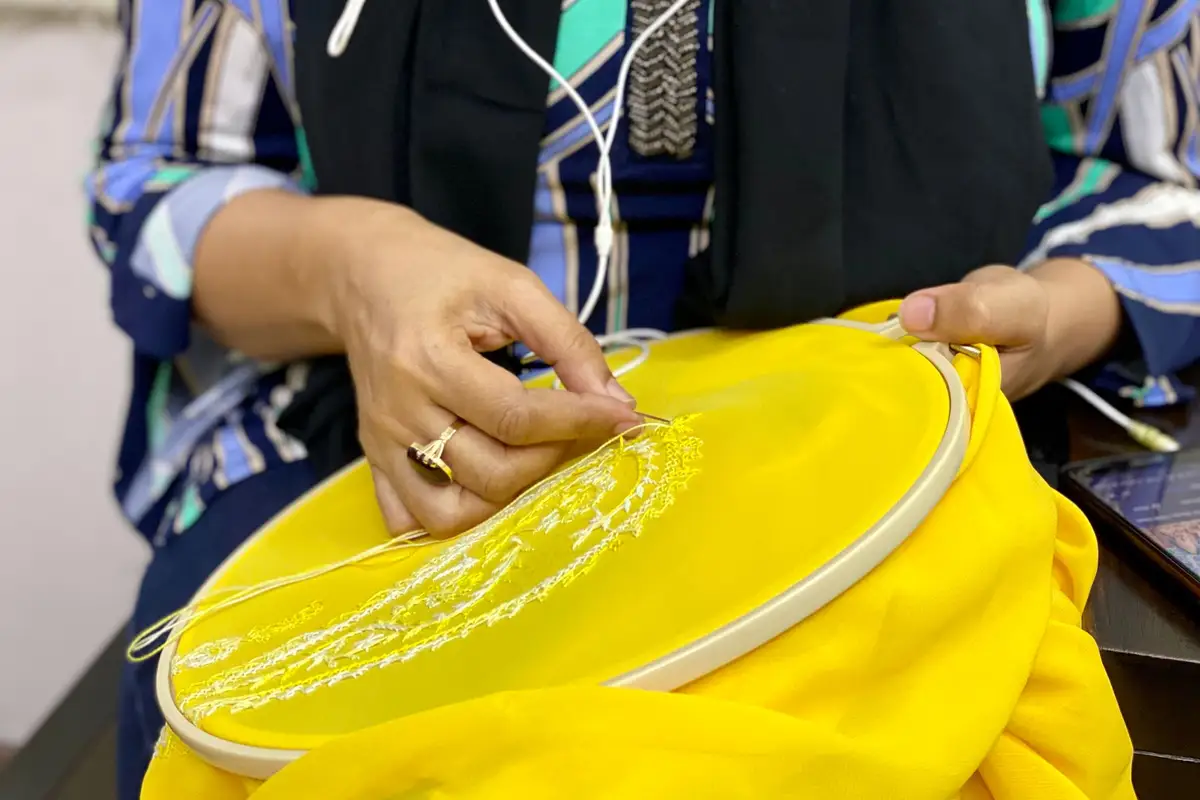
After you approve the sketch and book your slot, your lehenga goes behind the studio into the workshop. Before a single stitch of zardozi, the design has to be moved from paper to fabric. This is the khaka, and it is one of the oldest steps in Jaipur embroidery.
Our pattern master, Mohan, first draws each panel of the skirt at full size on tracing paper, working from your sketch and your measurements. A border motif may be drawn once and repeated, but the main field is drawn in full. This takes two to three days for a bridal skirt.
He then pricks along every line of the drawing with a fine needle, leaving a row of tiny holes. The tracing is laid on the fabric, and a cloth pad dipped in a paste of chalk powder and kerosene is rubbed over it. The powder passes through the holes and leaves a dotted outline on the velvet or silk. On pale fabrics we use a blue powder that washes out completely.
The fabric is then stretched tight on the adda, a wooden frame about two metres long, and laced to it at the sides. Four karigars sit along the frame, each working on a section, following the dotted lines with the hooked ari needle and metal thread. If you visit at your second fitting, you can see this stage yourself. Many brides find it the moment the lehenga becomes real.
Keep reading
Fabrics, juttis, bangles and lunch: how to plan a fitting weekend around the old city’s bazaars.
Night temperatures fall to 6 °C in January. How to stay warm without hiding your lehenga.
Six months is the right time to start. Here is what happens in each of them.