Coimbatore’s machining cluster, briefly explained
From textile mills and pumps to aerospace parts: why so many machine shops grew up along the Noyyal river.
Aerospace and automotive work · First-article samples in 10 working days
SF 214, SIDCO Industrial Estate, Kurichi, Coimbatore 641021
Mon–Sat · 8.30 am – 6 pm · two shifts
Bar feeders, guide bushes and a part every 40 seconds: what our Swiss-type section does between 6 am and 2 pm.
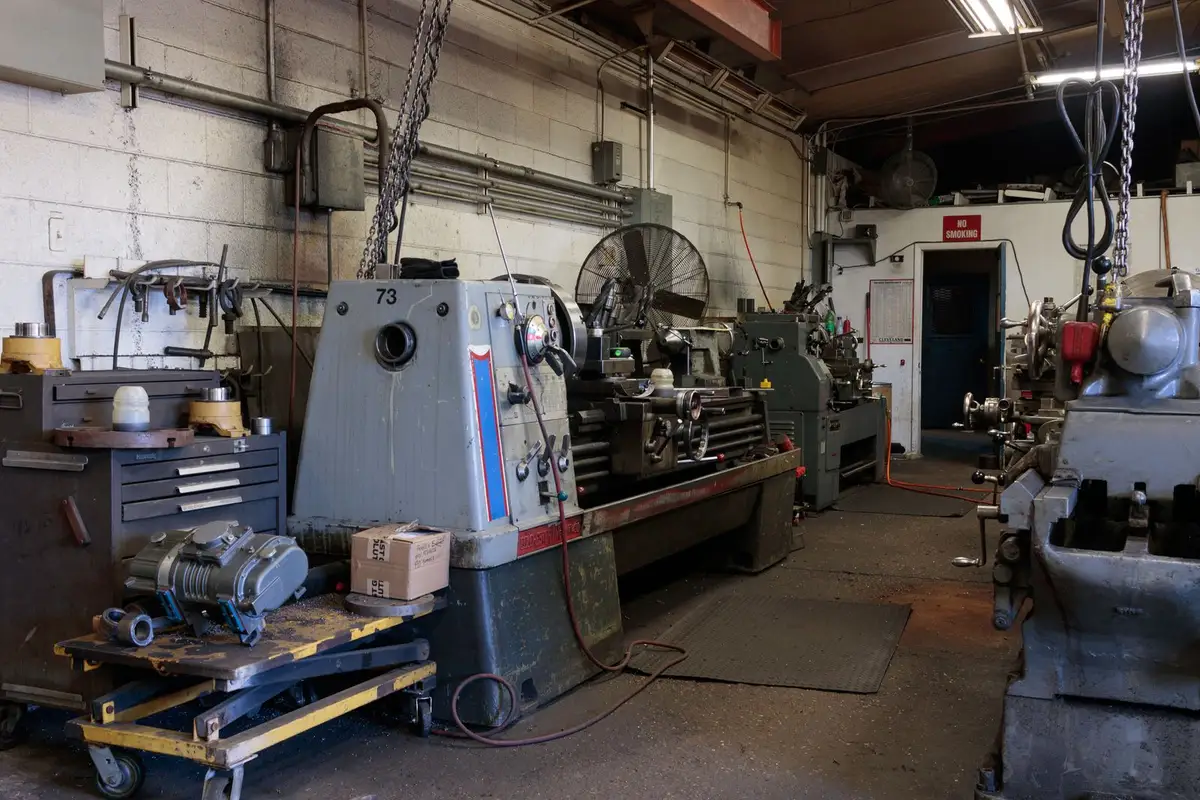
At the back of our main shed in SIDCO Kurichi, six sliding-head lathes run almost without pause. They make our smallest parts: knurled pins, sleeves, valve stems and connectors, often less than 12 mm across and sometimes thousands in a day. Here is what a morning shift looks like in that section.
The shift starts at 6 am with a handover. The night operator tells Prakash, who leads the morning shift, which machines are running which jobs, how many parts are done and any tool that is near the end of its life. Prakash walks the line, checks each machine’s counters and pulls the first parts off each to measure.
A sliding-head lathe works differently from an ordinary lathe. The bar, three metres long, is fed through a guide bush, and the headstock slides the bar forward while the tools stay close to the bush. This holds slender parts rigid while they are cut, so a pin 2 mm across and 30 mm long can be turned to within a hundredth of a millimetre. When one bar is used up, an automatic bar feeder pushes in the next.
Through the morning, the operators load bars, empty the chip bins, change worn inserts and measure a sample part every half hour with micrometers and a profile projector. Results go into a log beside each machine. Every two hours, the inspector takes a sample to the CMM room. At 2 pm, the next shift takes over, and the handover begins again. A good shift is a quiet one.
Keep reading
From textile mills and pumps to aerospace parts: why so many machine shops grew up along the Noyyal river.
Each extra decimal place on a drawing costs time and money. How to tell which dimensions really need ±0.01 mm.
Our holiday calendar, how supplier closures ripple through lead times and when to place orders for November and January.