
Soy or beeswax: how to choose
Two natural waxes, two different candles. What each smells like, how long they last and where each one belongs.
Saturday candle-making workshops in Assagao · Shipping across India in 3–6 days
House 214, Badem Church Road, Assagao, Bardez, Goa 403507
Tue–Sun · 11 am – 7 pm · Workshops Sat 4 pm
The first burn sets the memory of the wax. How long to let it run, how to trim the wick, and when to stop.
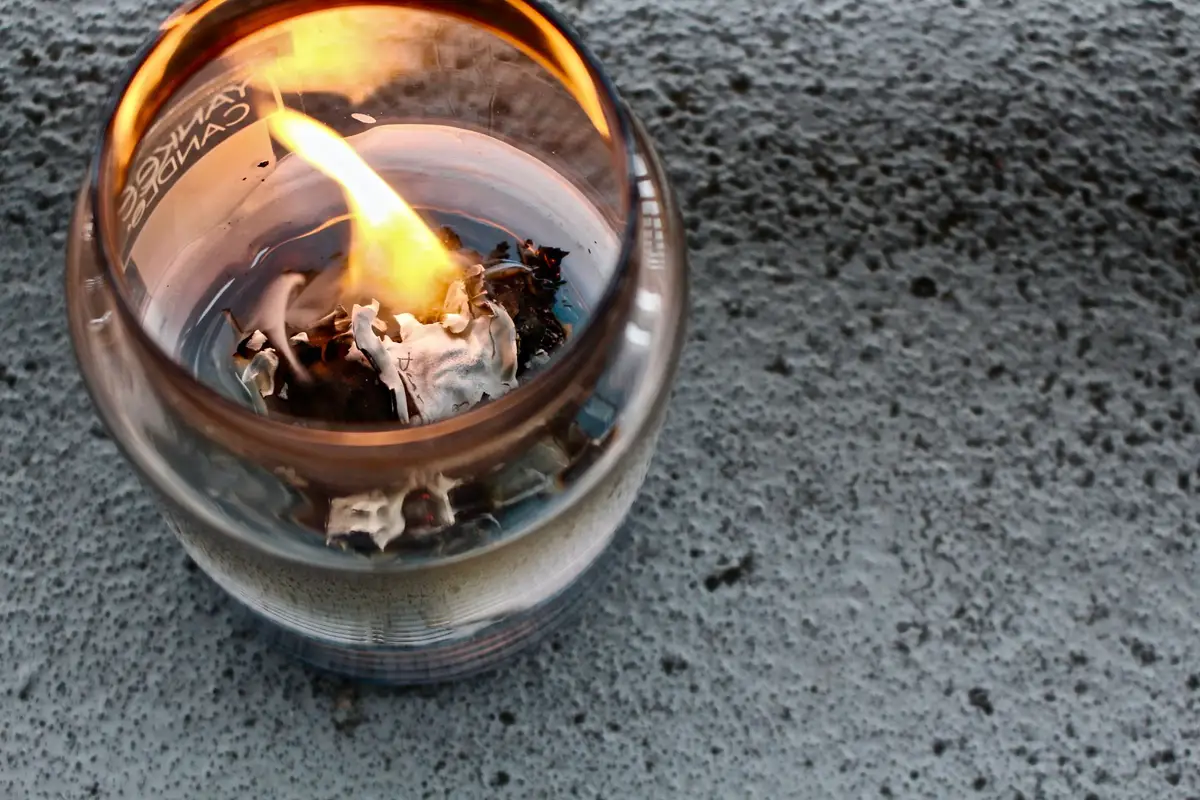
A candle that burns a narrow hole down the middle, leaving a thick wall of wax around the edges, is called tunnelled. It wastes a third of the candle and drowns the wick. It almost always starts on the first burn.
Wax has a memory. The first time you light a candle, let it burn until the melted pool reaches the edge of the jar. For our 200 g jars that is two to three hours. If you blow it out after 30 minutes, the next burn will follow the same small circle, and it gets deeper each time.
Before every burn, trim the cotton wick to about 5 mm with scissors or a wick trimmer. A long wick makes a tall, flickering flame, black smoke and soot on the glass. A wooden wick should be trimmed to about 3 mm, and the charred edge pinched off.
Keep the candle away from fans, open windows and air-conditioner vents. In Goa, where a fan is on most of the year, a draught is the main reason for an uneven burn. Do not burn a candle for more than four hours at a stretch, and stop when about 1 cm of wax is left at the bottom. If a candle has already tunnelled, wrap a band of foil around the top of the jar, leaving the middle open, and light it. The foil reflects heat onto the walls and evens the pool in an hour or so.
Keep reading
Two natural waxes, two different candles. What each smells like, how long they last and where each one belongs.
Wax, scent, glass, two weeks on a rack and a person at the pouring table: how the price of a 200 g candle adds up.
A Tuesday morning at the pouring table: melting, weighing, the two pours and the long wait on the racks.