Planning yarn orders around Deepavali and the export calendar
When knitters in Tiruppur buy, when mills slow down, and how to avoid a gap in supply in October and November.
Mill-direct yarn for knitters and weavers · Minimum order 1 tonne · Despatch from Salem
SF 118/2, Omalur Main Road, Karuppur, Salem 636012
Office Mon–Sat · 9 am – 6 pm · mill runs 24 hours
Three ways to spin cotton, how the yarns differ in strength, hairiness and cost, and which suits your fabric.
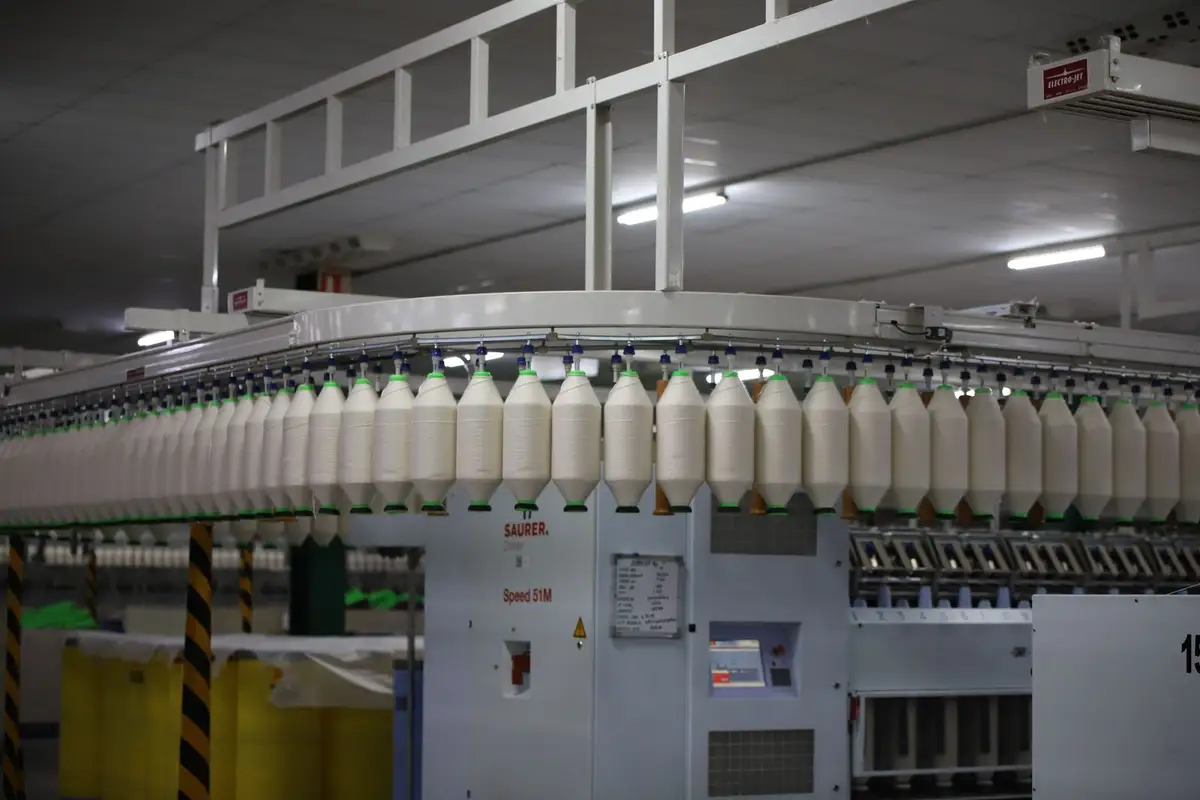
Buyers often ask for “good 30s” without saying how it should be spun. The spinning system changes the yarn as much as the cotton does, so it is worth knowing the three main kinds.
Ring-spun yarn is the traditional standard. Fibres are drafted and twisted on a ring frame, producing a strong, soft yarn with a natural feel. It suits most knitted and woven fabrics and is what we spin in our carded hosiery range. Its weakness is hairiness: short fibres stick out from the yarn surface, which can cause pilling and fly on the knitting floor.
Compact yarn is ring-spun with an extra step. Just before twisting, an air suction zone gathers the fibres tightly together, so far fewer stick out. The result is about 15 to 20 per cent less hairiness, higher strength and a smoother, more lustrous fabric. Our combed compact Ne 40s is popular for T-shirts and fine knits, especially for export. It costs more, usually ₹12 to ₹20 a kilo above ordinary combed ring yarn of the same count.
Open-end, or rotor, yarn is spun much faster in a rotor. It is more even and cheaper but weaker and harsher, and is mostly used in coarse counts below Ne 20s for towels, denim and industrial fabrics. We do not spin open-end yarn. In practice, choose compact for fine knitwear and fabrics where surface finish and pilling matter, ring-spun carded for everyday hosiery and value garments, and open-end only for coarse, heavy fabrics. Send us your fabric type and we will suggest a count and system.
Keep reading
When knitters in Tiruppur buy, when mills slow down, and how to avoid a gap in supply in October and November.
Blow room, carding, combing, drawing, roving, ring frames and winding: how cotton becomes a cone of yarn.
Where cotton is spun, knitted, woven, dyed and traded in western Tamil Nadu, and how yarn moves between towns.