Salem, Tiruppur and Erode: how the Kongu textile belt works
Where cotton is spun, knitted, woven, dyed and traded in western Tamil Nadu, and how yarn moves between towns.
Mill-direct yarn for knitters and weavers · Minimum order 1 tonne · Despatch from Salem
SF 118/2, Omalur Main Road, Karuppur, Salem 636012
Office Mon–Sat · 9 am – 6 pm · mill runs 24 hours
Blow room, carding, combing, drawing, roving, ring frames and winding: how cotton becomes a cone of yarn.
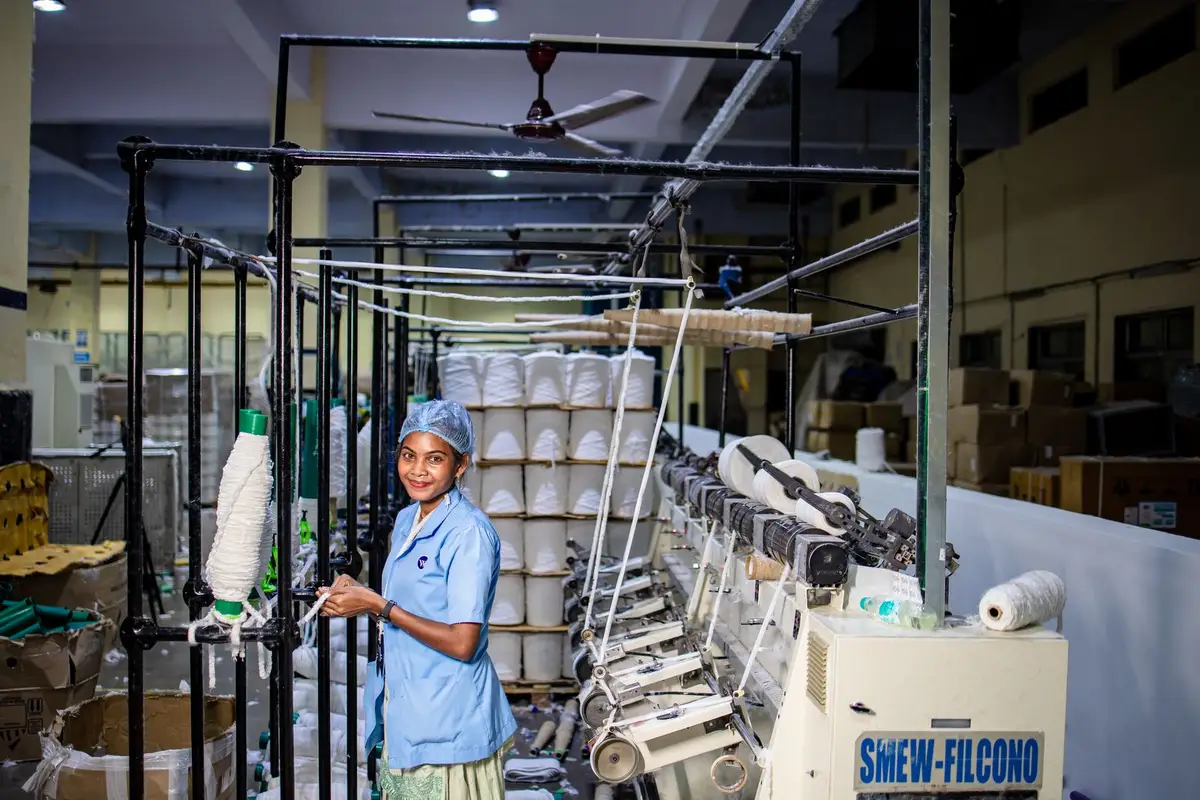
Our mill on the Omalur road runs three shifts, every day of the year except a few festivals. In 24 hours, about 30 tonnes of cotton passes through the floor. Here is the route a single bale takes.
Bales of 170 kg arrive from ginneries in Gujarat and Telangana and are tested in our lab for staple length, strength and micronaire. They are laid out in a line of 40 or more in the blow room, where a machine takes thin slices from each bale in turn. This mixing evens out differences between bales. The cotton is then opened into small tufts and cleaned of leaf, seed and dust.
Carding comes next. Fine wire teeth on rotating cylinders separate the fibres and lay them roughly parallel, producing a soft rope called sliver. For combed yarn, the sliver goes through lap formers and combers, which remove the short fibres. Several slivers are then drawn together on draw frames to even out any thick and thin places.
The speed frame turns sliver into roving, a thinner strand with a slight twist, wound onto bobbins. On our 62,400 ring spindles, the roving is drafted to its final thickness and twisted into yarn at up to 18,000 revolutions a minute. Finally, autoconers wind the yarn from small bobbins onto large cones, cutting out any faults detected by electronic clearers and joining the ends with an air splice. Samples from each lot go to our lab for count, CSP and evenness testing, and the lot sheet is printed before the cones are bagged.
Keep reading
Where cotton is spun, knitted, woven, dyed and traded in western Tamil Nadu, and how yarn moves between towns.
Why Ne 60s is not automatically better than Ne 30s, and how to pick the count your fabric actually needs.
Cotton, waste, power, labour, packing and transport: a plain breakdown of carded hosiery yarn costs.