Planning bridal jewellery on a budget
How families split a budget across pieces, and where old gold fits in.
22K gold, weighed in front of you · Lifetime exchange at today’s gold rate
52 Big Bazaar Street, Town Hall, Coimbatore 641001
Mon–Sat · 10 am – 8.30 pm · Sun by appointment
Where the style comes from, and how a Lakshmi haram is made by hand.
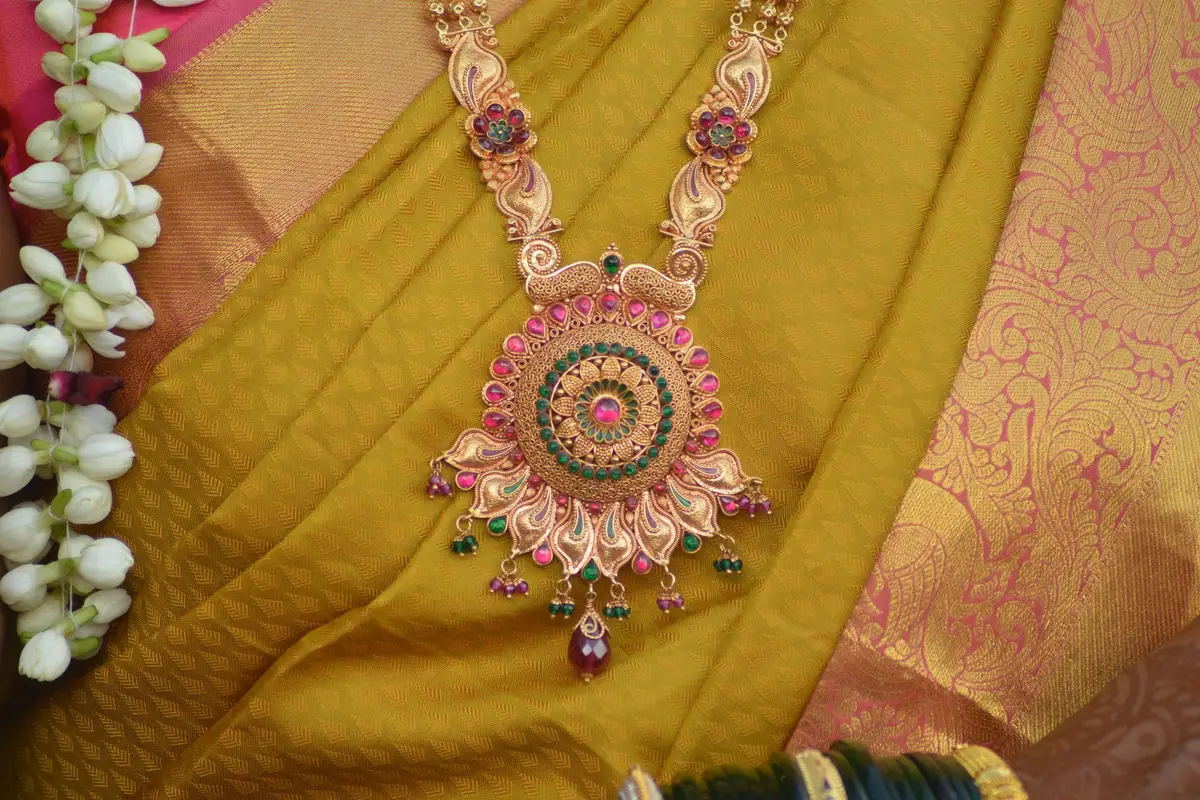
Temple jewellery began as ornaments for the deities in South Indian temples, and later for Bharatanatyam dancers who performed in them. The motifs come straight from the temple walls: Lakshmi seated on a lotus, peacocks, mango buttas, the gopuram and the swan called annam.
A Lakshmi haram like the one in our bridal vault starts as a sheet of 22K gold. Each coin is pressed in a steel die, then the karigar works the face by hand with small punches, deepening the lines of the figure so it catches light. This chasing is what separates a handmade haram from a cast one; look at the coin edge-on and you can see the depth.
The coins are then linked one by one, with small gold beads between them, and the pendant is set with rubies or red stones in a closed setting. A haram of 21 coins takes our workshop about three weeks from sheet to polish.
Temple pieces are heavy, so we balance them for wear. The back of the necklace is kept flat and smooth, and the pendant weight is checked so the haram hangs straight rather than twisting. If a family haram has started to twist, bring it in; it can usually be rebalanced in a day.
Keep reading
How families split a budget across pieces, and where old gold fits in.
Soap, a soft brush and separate pouches: the routine that keeps 22K gold bright between workshop visits.
Three looks that are often confused at the counter, and what each one means for weight, price and wear.