Buying gold for Akshaya Tritiya and Deepavali
Why the two busiest gold days crowd every shop, and how to plan a calmer, cheaper festival purchase.
22K gold, weighed in front of you · Lifetime exchange at today’s gold rate
52 Big Bazaar Street, Town Hall, Coimbatore 641001
Mon–Sat · 10 am – 8.30 pm · Sun by appointment
Three looks that are often confused at the counter, and what each one means for weight, price and wear.
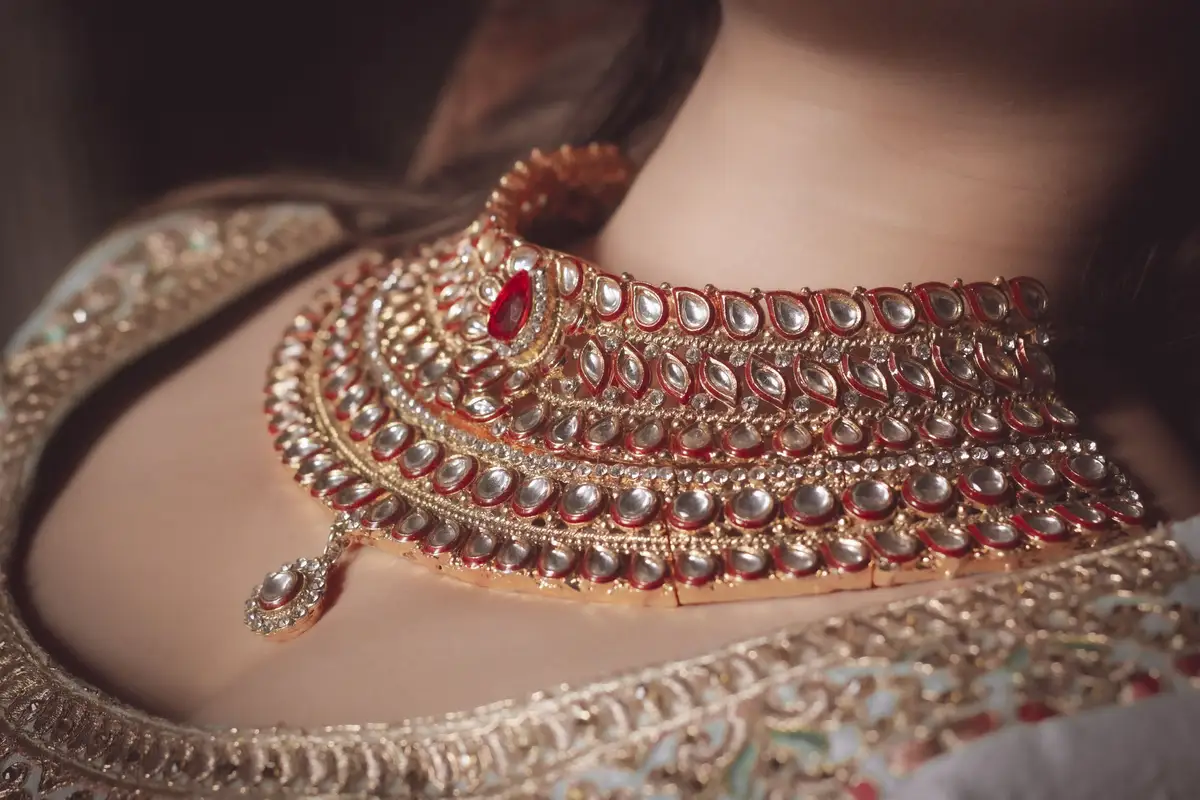
Customers often use kundan, polki and antique as if they meant the same thing. They are related, but each describes something different, and the difference shows up on the bill.
Kundan is a setting technique. Thin strips of highly refined gold foil are pressed around each stone to hold it in place, without prongs. The stones are often glass or semi-precious, and the back of the piece is usually enamelled in colour. Because the look comes from the setting, kundan pieces can be lighter in gold for their size. Our kundan jhumkas weigh 18.6 g the pair.
Polki refers to the stone itself: an uncut or lightly cut diamond, kept close to its natural shape, with a flat back. Polki is usually set kundan-style, which is where the confusion starts. A polki piece costs far more than a kundan piece of the same size, because the stones are diamonds, and they are weighed and priced separately on the bill.
Antique is a finish, not a stone or a setting. After polishing, the gold is treated so that the surface takes on a darker, aged tone, which makes rubies and emeralds stand out. The gold underneath is the same 22K. Antique pieces carry a higher making charge, around 16 to 18%, because the finishing adds a day or two of work. When you shop, ask three questions: what are the stones, how are they set, and what is the surface finish. A clear answer to all three tells you what you are paying for.
Keep reading
Why the two busiest gold days crowd every shop, and how to plan a calmer, cheaper festival purchase.
From a plain gold band to a creeper pattern: six days at the bench with our engraver, Murugesan.
Parking, the quietest hours, where to eat and what else to see around Town Hall in Coimbatore.