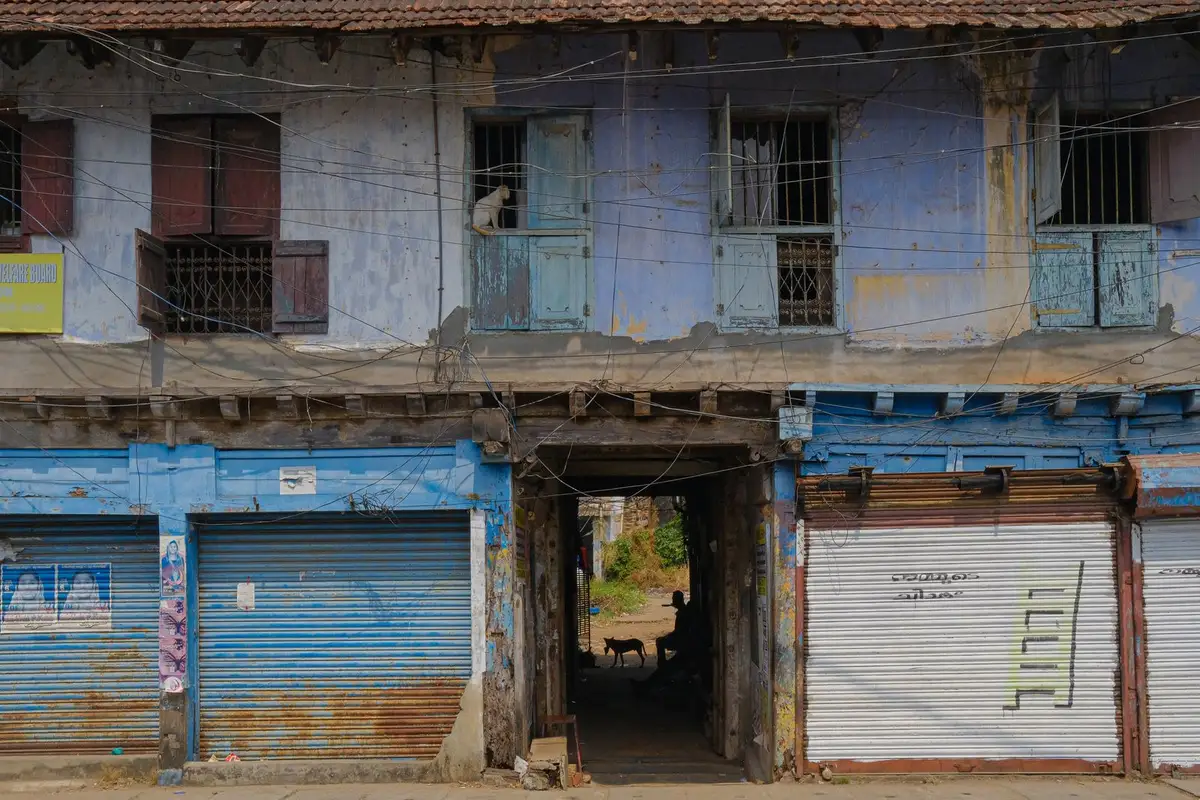
Mattancherry for furniture lovers: an afternoon walk
Old godowns, antique shops and carved doors around Bazaar Road and Jew Town, starting from our workshop.
Free delivery and fitting across Kerala · Made to order in 4 to 6 weeks
6/412 Bazaar Road, Mattancherry, Kochi 682002
Mon–Sat · 9.30 am – 7 pm
The joint that holds most of our furniture together, and how our carpenters cut it with a saw and chisel.
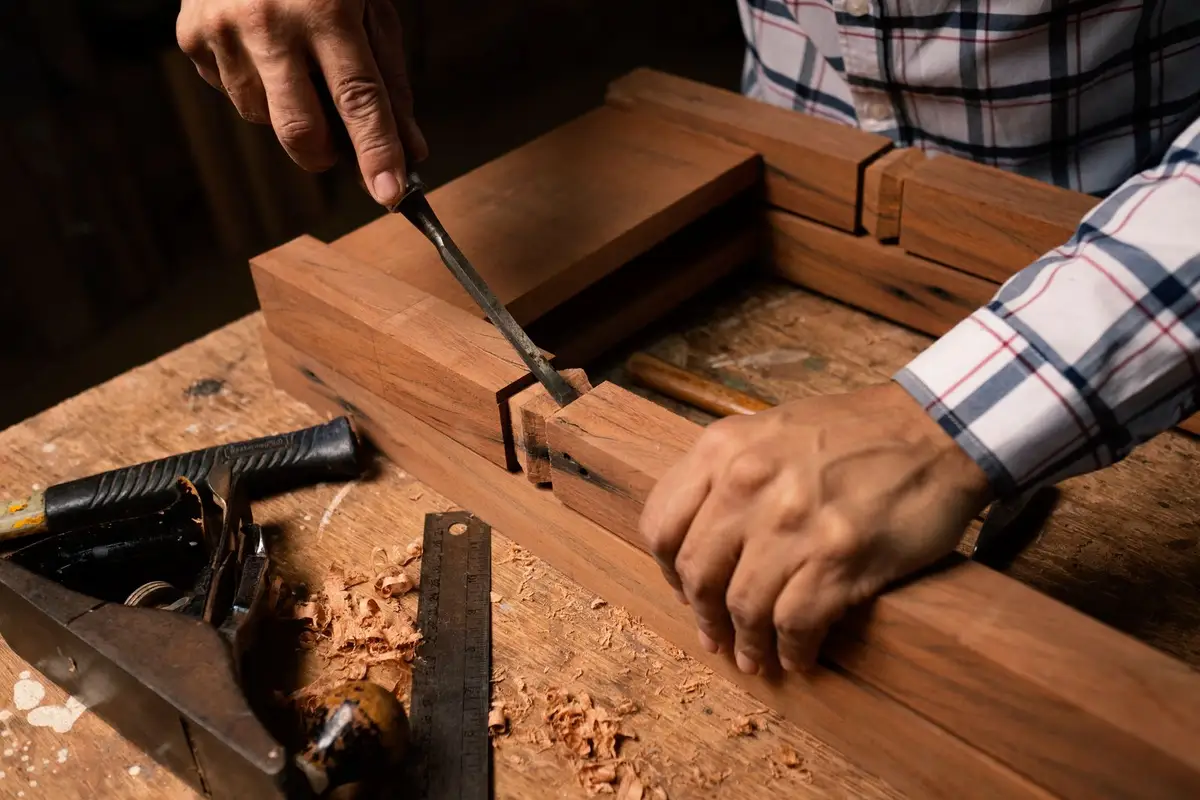
Almost every chair, table and bed frame that leaves our workshop is held together with mortise and tenon joints. Here is how our carpenters cut one, using the leg and rail of a dining table as an example.
The mortise is a rectangular hole cut into the leg. Saji, who has been with us for nineteen years, first marks it with a marking gauge and a sharp knife, usually one third of the thickness of the rail and about 50 mm deep. He then drills out most of the waste with a bench drill and cleans the walls square with chisels, checking with a try square every few cuts. The walls must be flat and parallel; a mortise that tapers will never hold tightly.
The tenon is the tongue on the end of the rail that fits into the mortise. It is marked from the same gauge setting, so the two match exactly, then cut with a tenon saw along the grain and across it at the shoulders. The fit should be firm enough that the rail has to be tapped in with a mallet but not so tight that it splits the leg. Most of a carpenter’s skill goes into those last few shavings.
Once the fit is right, the joint is glued and clamped, and on our dining tables, a teak peg is driven through the leg and tenon to lock it. A well-cut joint like this does not rely on screws, and it can be taken apart and reglued by a carpenter decades later.
Keep reading
Old godowns, antique shops and carved doors around Bazaar Road and Jew Town, starting from our workshop.
Nilambur teak is grown in plantations. Here is what that means for strength, colour and how long it lasts.
From the first visit to the delivery day, how an order works at our workshop and how long each step takes.