Why a handmade mug costs ₹850
Clay, glaze, a dozen pairs of hands and two kiln firings: the real cost of our speckled stoneware mug.
New firing every second Friday · Every piece packed by hand and insured in transit
27 Rue Romain Rolland, White Town, Puducherry 605001
Tue–Sun · 10 am – 6 pm · closed Mondays
Which marks are part of handmade pottery and which ones mean a piece is sold as a second, explained plainly.
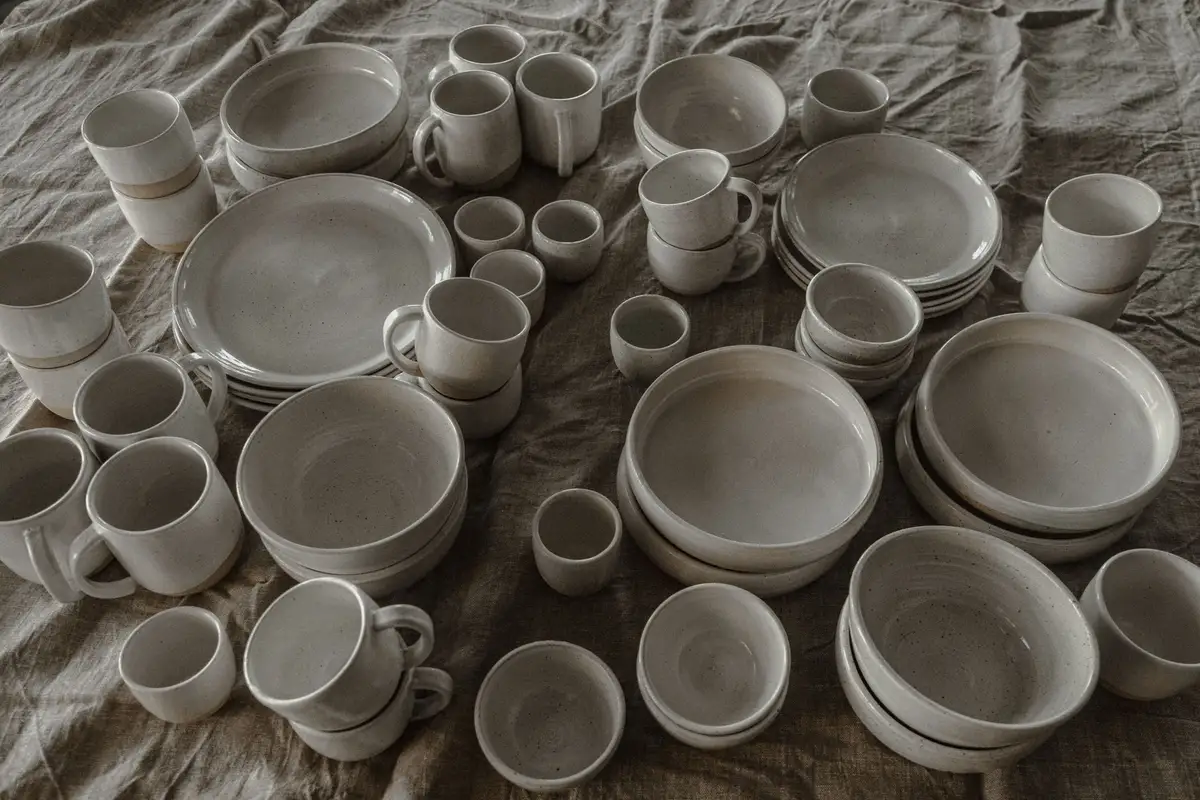
Every piece we make is checked by hand when the kiln is unloaded, and each one goes into one of three groups: firsts for the shop and website, seconds for the studio shelf at a lower price, and a small number that are broken up and used as garden drainage. Here is how we sort them.
Some marks are simply the nature of handmade stoneware, and they stay with the firsts. Iron speckles in the clay, small changes in glaze colour from one side to the other, a rim that is very slightly uneven and throwing lines on the inside of a mug are all signs of the hand and the kiln. We see them as part of the piece.
Other marks make a piece a second. Pinholes are tiny holes in the glaze surface left by gas escaping during firing; one or two on the outside are cosmetic, but any on the inside of a mug or bowl move it to seconds. Glaze crawling, where the glaze pulls back to leave a bare patch, and a wobble on a flat surface both count as seconds. Seconds are sold at the studio for 30 to 40% less, clearly marked, and never sent out as firsts.
Crazing, a network of fine cracks in the glaze, is the one flaw we do not sell at all. It can trap food and liquid, so any crazed piece is broken up. Our glaze recipes are tested to avoid it. If you ever see crazing appear on one of our pieces, write to us and we will replace it.
Keep reading
Clay, glaze, a dozen pairs of hands and two kiln firings: the real cost of our speckled stoneware mug.
From the first sample to the delivery of 200 cups: how we work with cafés, restaurants and hotels on custom tableware.
Why a mug takes three weeks to make, and what happens in the kiln.