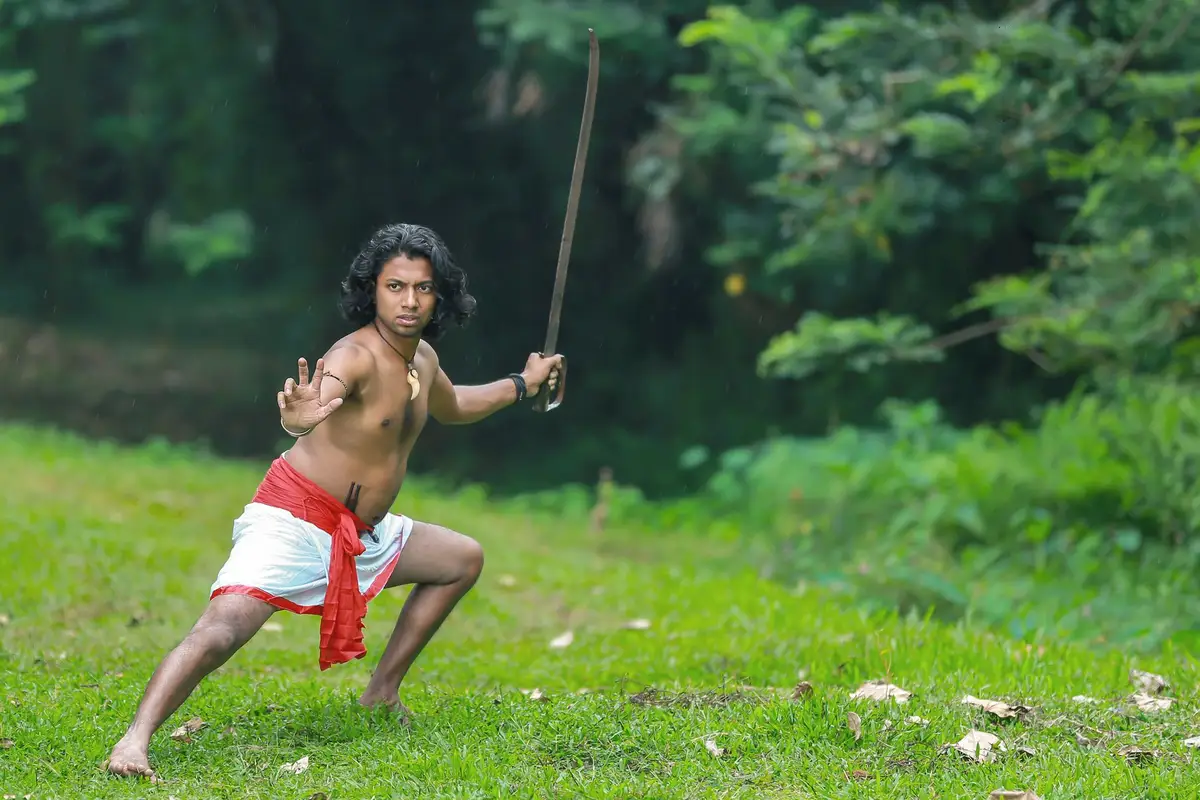
Kalaripayattu and silambam: what is the difference
One is from Kerala, one from Tamil Nadu. Both start with the feet.
New beginners’ batches start on the 1st of every month · First class free
Kalari Road, near Thali Temple, Chalappuram, Kozhikode 673002
Mon–Sat · 6 – 9 am, 5.30 – 9 pm · Sun 7 – 10 am
Why our training floor is four feet below the ground, and what the poothara is.
Visitors to Chuvadu are often surprised to step down into the kalari. Ours is a kuzhi kalari, a pit kalari, the traditional form in north Kerala.
The floor is dug about four feet below ground level and made of beaten mud. The walls of earth keep the space cool in summer and sheltered from wind during the monsoon. The mud floor is softer than concrete for falls and rolls, and it gives the feet a grip that tiles cannot.
The kalari is laid out along the east–west axis. In the south-west corner stands the poothara, a seven-tiered platform dedicated to the guardian deity of the kalari, with an oil lamp lit before each session. Students touch the floor and the poothara when they enter, a gesture of respect for the space and for those who trained before them.
We rebuilt our floor in 2008 with clay from a nearby field, beaten and smoothed by hand over three weeks. Every year before the monsoon, the floor is repaired and re-plastered.
You do not need to share any particular belief to train here. But we ask every student to treat the kalari with care, and most come to value its quiet.
Keep reading
One is from Kerala, one from Tamil Nadu. Both start with the feet.
What to eat, what to wear and what the first ninety minutes look like.
How to oil, store and check a kettukari or silambam staff so it stays straight and does not split.