Planning a home mehendi function
Space, light, timing and how many artists you need for the number of guests.
Karwa Chauth slots open from 10 October · Bridal dates for November to February filling
17 Shahnajaf Road, Hazratganj, Lucknow 226001
Tue–Sun · 11 am – 8 pm · home visits by booking
The jaali, keri and phool of Lucknow’s embroidery work just as well in henna. How we borrow them.
Walk through the lanes behind Chowk and you will see women bent over white cloth, working tiny shadow stitches and open jaali by needle. Many of our brides wear chikankari at the mehendi or the nikah, and over the years we started borrowing its motifs for the hands.
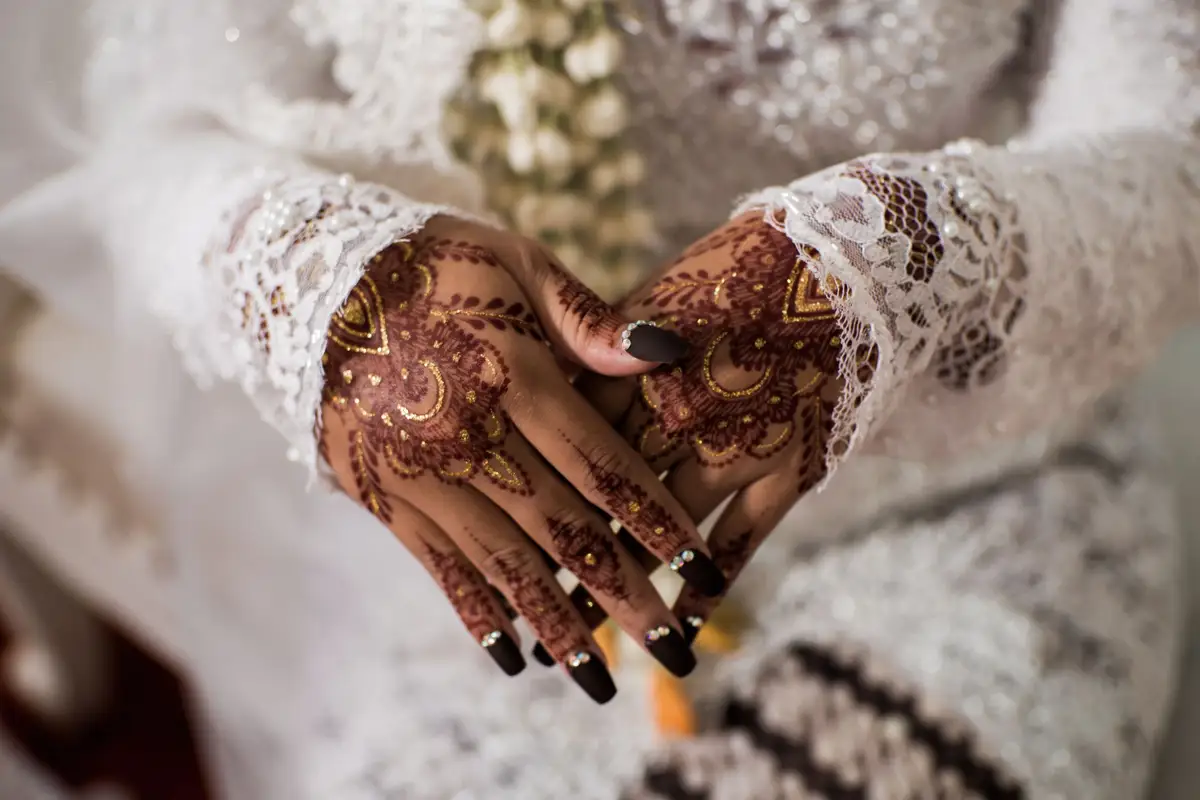
The most useful is the jaali, the open net that chikan work is known for. In mehendi it becomes a fine lattice on the back of the hand, drawn with a thin cone, with the skin showing through. It stains evenly and looks lighter than a solid fill, which suits brides who do not want very dark hands.
The keri, or paisley, appears in both crafts. In chikankari it is outlined in bakhiya stitch; we draw it with a double line and leave the middle open or fill it with tiny dots. The phool, a small five-petal flower, scatters well across the fingers. Creeping vines, called bel, link these shapes the way they link motifs on a kurta.
If you are wearing a chikan outfit, bring a photo of the embroidery to your trial. We can pick one motif from the neckline or the border and repeat it on your palm or wrist. It is a small detail, but it ties the hands to the clothes in photographs, and guests from Lucknow always notice it.
Keep reading
Space, light, timing and how many artists you need for the number of guests.
Why two bridal quotes can differ by ₹10,000, and what your quote should include.
The two busiest days of our year, and how to get a slot without waiting in a queue.